Initiatives and work items
Initiatives
Section titled “Initiatives”An initiative is a promise to deliver something by a date: “Acme site relaunch, 15 October”, “Payments v2 live by 30 November”.
An initiative is not a project and it does not own work. It is a layer across your projects. The tasks stay where they are. The initiative pulls the relevant pieces together under one outcome and rolls their health up.
An initiative has a title, a description, a target date and a status: draft, active, paused, completed or cancelled.
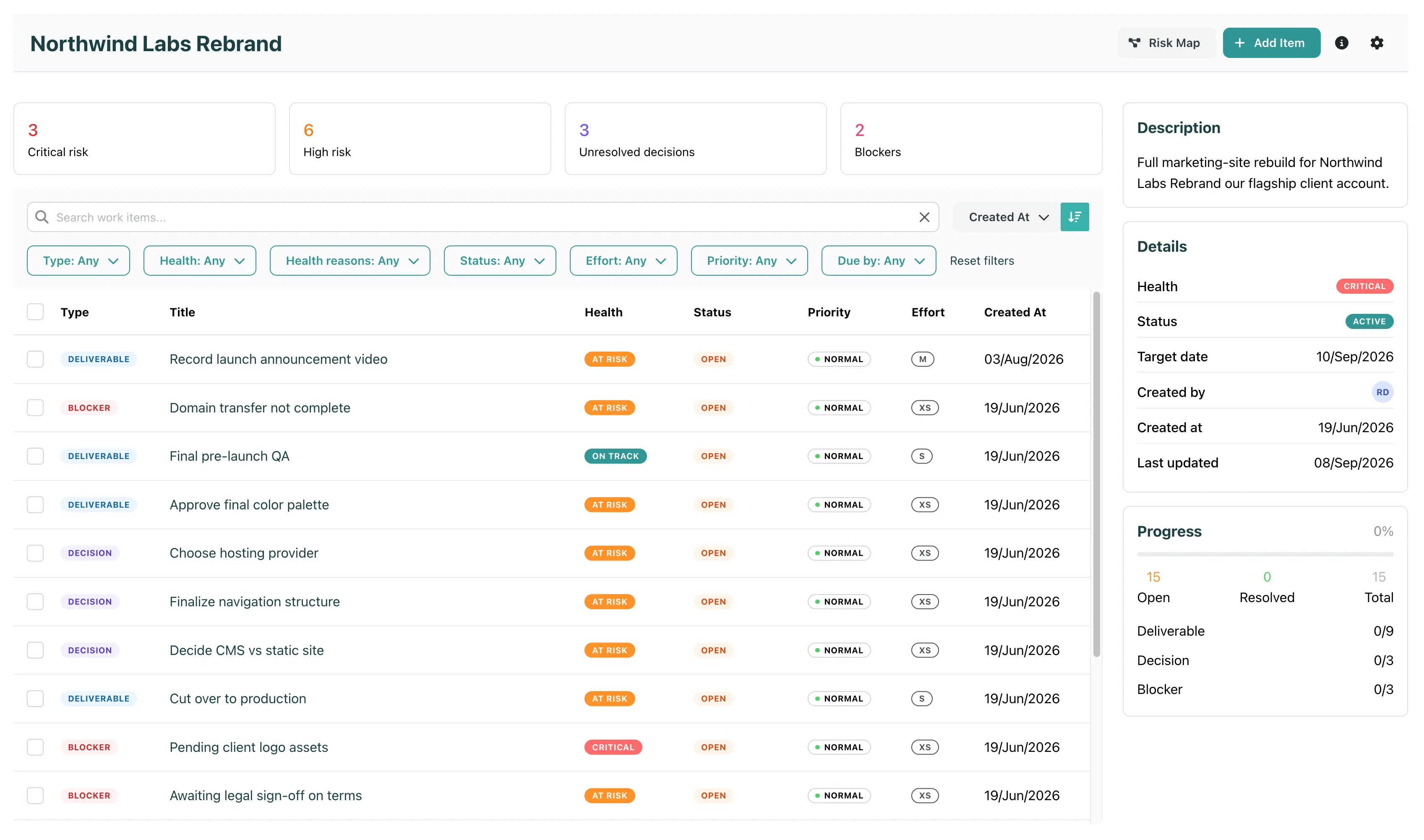
Work items
Section titled “Work items”An initiative is made of work items. A work item is one piece of the promise. It has one of three types:
- Deliverable. Something that must be built or done. Usually links the tasks that do it.
- Decision. Something that must be decided, by someone. Often links no task at all.
- Blocker. Something outside the team that stands in the way: a client sign-off, a contract, a domain transfer.
A work item has a status (open, resolved, dismissed), a priority, an effort size, an optional due date and an assignee.
Under a work item you link the things that move it: tasks from any project, GitLab or GitHub issues and merge requests, calendar events, people, notes. Or you link nothing. A decision that is only a decision is a valid work item.
When to use an initiative
Section titled “When to use an initiative”If the projects are independent and each promise fits in one iteration, iterations are enough. Initiatives earn their place in three cases:
The promise is longer than one iteration. “Site live 15 October” is six two-week iterations. Each one can be green and the promise still misses, because nobody compares all remaining work against 15 October. The iteration is the team’s clock. The promise is the client’s clock.
The promise has pieces that are not tasks. A client sign-off, a decision that went quiet, a GitLab issue. An iteration cannot hold them, so it cannot go red because of them.
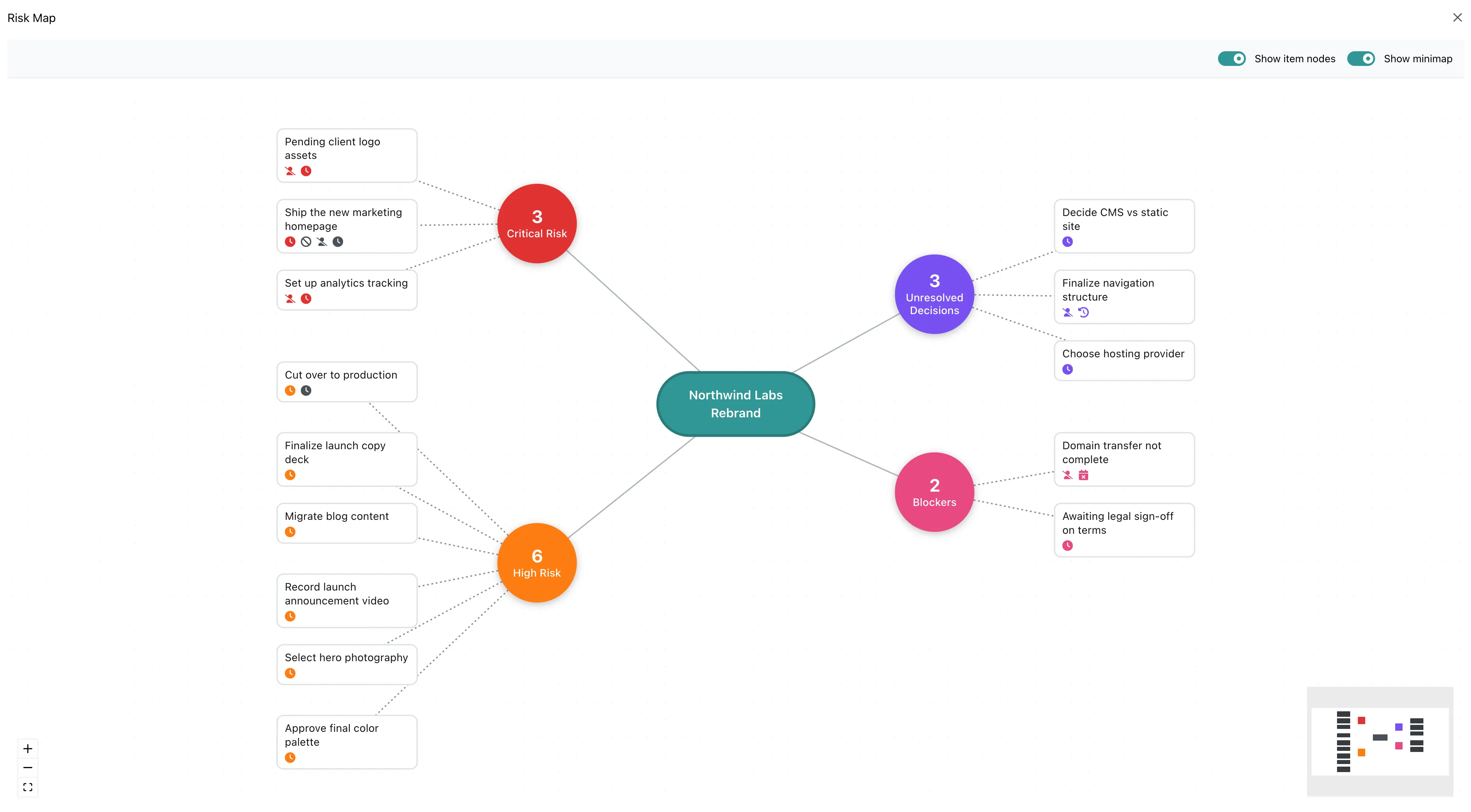
You need the why, across projects. Iteration health says “at risk, 2 overdue”. The initiative says which promise is in trouble and because of which piece.
Short form: iterations tell you if the team is on pace this sprint. Initiatives tell you if the thing you promised will land. When those are the same question, skip initiatives.
Roll-up
Section titled “Roll-up”A work item goes at risk or critical when any task, issue or blocker under it is overdue, blocked, unowned or stale, and it names the cause. The initiative goes at risk or critical when any of its work items does, or when the open work does not fit the team’s capacity before the target date. See Health.
Nothing moves and nothing is duplicated. A task that goes overdue three levels down in some project backlog surfaces on the initiative, with no one updating anything.